Medical Sales Interview Questions (and How to Answer Them)
Short answer: Medical sales interviews test one thing in every round: can you communicate clearly, handle rejection and keep going when it gets hard? Expect questions about why you want medical sales, why you over someone with experience, how you handle objections and rejection, and a role play. Answer in 30-60 seconds with one real number, use the STAR method for behavioral questions, and close every round by asking for the next step.
Below are the questions that come up most, with sample answers built from 20+ years in medical device sales. Use them as a frame, not a script. Managers can hear a memorized answer from across the room.
Free guide: 5 resume mistakes costing you medical sales interviews, with the exact fixes. Get the free resume guide
What are the stages of a medical sales interview?
Most companies run four or five rounds:
- Recruiter or HR screen: do you sound worth advancing? Clear, tight answers win here.
- Hiring manager interview: can you sell? Expect behavioral questions and objection handling.
- Panel or team interview: can the team work with you? Answer the person who asked, then include the group.
- Presentation or role play: a product pitch, "sell me this pen" or a mock sales call.
- Final interview or ride-along: would they trust you with their accounts and their surgeons? Nothing in this round is casual.
The biggest mistake candidates make is treating this like a normal job interview. A medical sales interview is a sales call, and you are the product.
Questions about you
1. Tell me about yourself.
Open with your real background and your best result, then show this is a planned move. Sample: "I come from a background where performance, preparation and follow-through mattered. For the past six months I've been deliberately preparing for medical sales: studying the industry, talking with reps and managers, and learning how top performers run their territory. This isn't a random move. It's a planned transition."
2. Why do you want to work in medical sales?
Avoid money-only answers. Sample: "Medical sales lets me combine competitive, goal-driven work with something that matters. I like building relationships, earning trust and helping clinicians do their jobs better. I want my performance tied to patient outcomes."
3. Why should we hire you over someone with experience?
Sample: "I may not have direct experience, but I've done the work to understand this industry, from product knowledge to outreach to interviewing. I bring a proven work ethic, a fresh perspective and no bad habits to unlearn. I'm ready to run your playbook at a high level."
4. What would your current manager say about you?
Sample: "That I'm dependable, prepared and consistent. I do the work even when no one's watching." Be ready to back it up. Managers often call references.
Questions about the company and role
5. What do you know about our company and products?
This is where generic answers end interviews. Name their product category, a specific product or initiative, and what it tells you about how they treat customers and reps. Do real research: the company site, product pages, procedure videos and recent news.
6. What does success look like in your first 90 days?
Sample: "Learning the products, understanding the territory, building a target list and setting a steady activity rhythm. By day 90 I want early pipeline and proof that I can move accounts forward." Then hand them a written plan. Here is how to build one: 30-60-90 day plan for a medical sales interview.
7. What questions do you have for us?
Always have some ready. Ask about ramp expectations, what success looks like in this territory, the habits of their top performers, and how the company supports new reps.
Selling questions
8. How would you sell to a doctor who is loyal to another brand?
Sample: "I'd start by understanding their current solution: what they like and what's missing. Then I'd position my product as an improvement or a complement, backed by data, outcomes or cost savings. Relationship first, solution second."
9. How do you handle price objections?
Sample: "I don't lead with discounts. First I find out what's really behind the objection: budget, perceived value or a cheaper option they're comparing us to. Then I bring it back to total value, like outcomes, time saved or lower total cost. If price is still the issue, I work with my manager on options instead of guessing."
10. How do you respond to "We're happy with what we have"?
Sample: "I acknowledge it, then ask what's working well and where they still see friction. That usually opens a real conversation."
11. How do you handle long sales cycles?
Sample: "I stay patient, organized and present. I focus on steady progress instead of forcing outcomes." Device sales cycles can run 3-12 months or more, so this matters.
Mindset questions
12. How do you handle rejection?
Sample: "I don't take it personally. I treat it as information. When I hear no, I want to know why: timing, fit, budget or trust. Then I adjust, improve and move on."
13. Tell me about a time you missed a goal.
Use STAR and own the miss. Example: "In my second quarter as a membership advisor, I finished at 82% of target. I owned that number and needed to fix it fast. I went back through every lost lead, realized I was following up too slowly, and built a 24-hour follow-up rule with a simple tracker. The next quarter I hit 118%, and my manager had the whole team adopt the tracker."
14. What separates top reps from average reps?
Sample: "Consistency, preparation and follow-through. Talent helps, but habits win."
15. How do you handle pressure?
Sample: "I focus on process. When the process is solid, results follow."
How to use the STAR method
Most hiring manager questions start with "Tell me about a time when..." STAR keeps you from rambling:
- Situation: set the scene in one or two sentences
- Task: what you were responsible for
- Action: what you did. Say "I," not "we"
- Result: what happened, with a number whenever you can
Prepare four or five STAR stories before every interview: a win, a miss you fixed, a time you influenced someone without authority, a time you learned something fast, and a time you persisted through rejection. You can adapt them to almost any question.
How to answer "sell me this pen"
The test is not the pen. It is whether you ask questions before you pitch.
- Ask first: "Before I tell you about this, how do you use a pen during your day? When did one last let you down?"
- Find the need: listen for something real, like signing contracts or taking notes in meetings.
- Connect the product to the need: "You sign contracts with clients. This pen writes clean every time, so the moment you close a deal never gets awkward."
- Ask for the business: "Does that sound like what you need? Can I put you down for one?"
The same four steps work for a product pitch to a mock surgeon. Ask, listen, connect, close.
How to close a medical sales interview
Close every round, first or final. Before you leave, ask:
- "Is there any reason I couldn't move on to the next interview?"
- "Do you have a date for the next interview I can put on my calendar now?"
Then send a short, specific thank-you email the same day that references something they said.
Get the free resume guide
Your resume is the first thing standing between you and an interview. Our free guide shows the 5 resume mistakes that cost career changers medical sales interviews, with real before and after examples and a message template that gets hiring managers to reply.
Download the free resume guide
Ready for the full plan? The Medical Sales Starter Kit includes the step-by-step guide, interview Q&A cheat sheet, cold outreach templates, resume template and job tracker.
Frequently asked questions
How long should my interview answers be?
Aim for 30-60 seconds, then stop. One real number beats three adjectives.
Should I memorize answers?
No. Keep the structure of each answer, swap in your own stories and numbers, and practice out loud until it sounds like you.
What should I bring to a medical sales interview?
Extra printed copies of your resume, a written 30-60-90 day plan for later rounds, and a brag book with proof of your results.
What is the hardest medical sales interview question?
For career changers it is usually "Why should we hire you over someone with experience?" Answer with preparation you have already done, a proven work ethic and a result with a number.
How do I prepare for a medical sales role play?
Learn the company's core product and the problem it solves, then practice the ask, listen, connect, close structure out loud. Managers care more about structure and how you recover than about a perfect pitch.
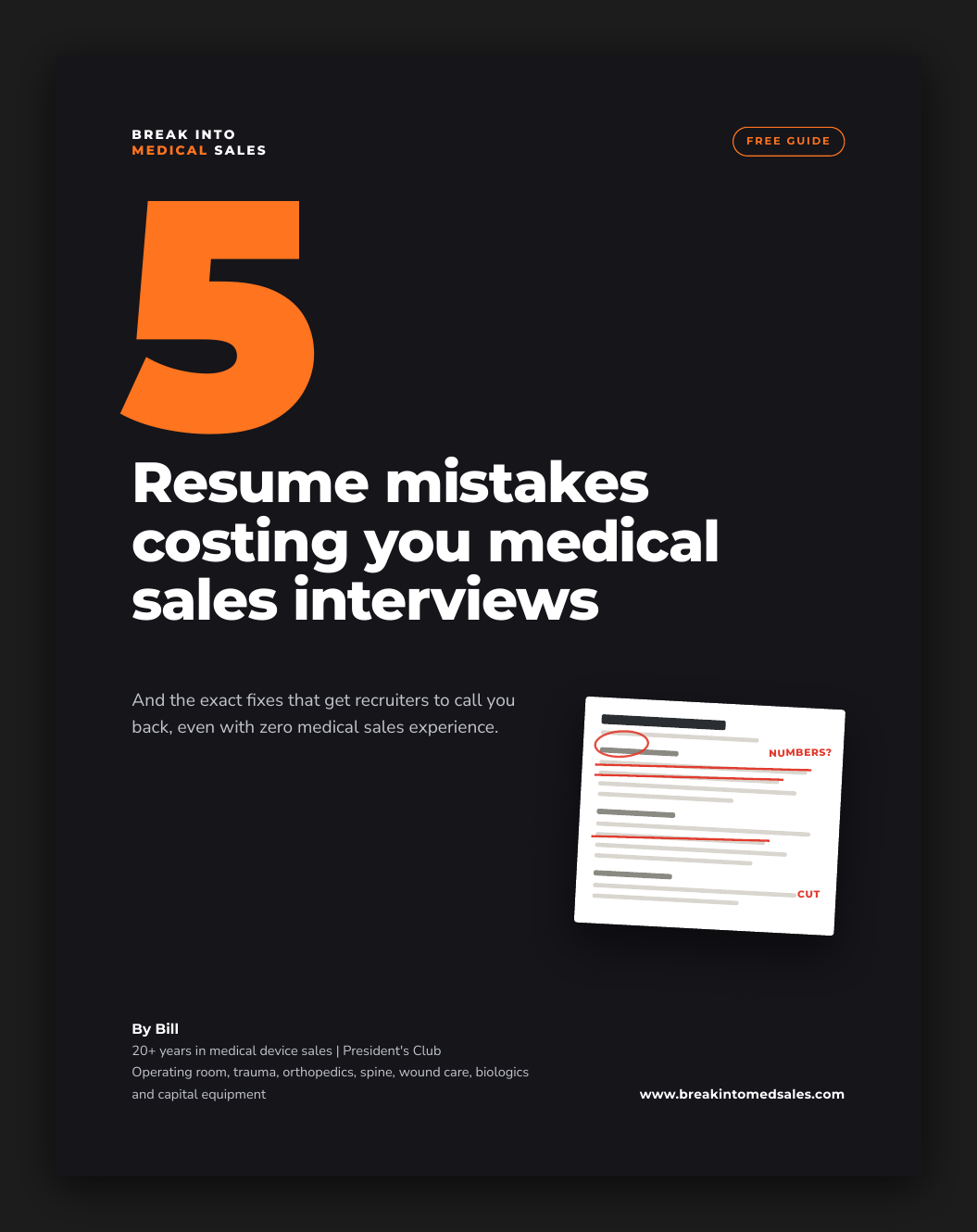
FREE RESUME GUIDE
5 resume mistakes costing you medical sales interviews, with real before and after fixes and a message template that gets hiring managers to reply.
Ready for the full plan? The Medical Sales Starter Kit has the step-by-step guide, interview cheat sheet, outreach templates and job tracker. See the kit
Break Into Medical Sales
Step-by-step guides and tools for career changers breaking into medical sales - built from 20+ years in medical device sales.
Quick links
Free resume guide
5 resume mistakes costing you medical sales interviews, and how to fix them.
Created with © systeme.io