How to Get Into Medical Sales With No Experience (2026 Guide)
Short answer: You can get into medical sales with no experience. Most entry-level roles are character-first hires, so hiring managers care more about proof that you can win, learn fast and follow up than about a sales title. The fastest path is to pick a segment, rewrite your resume around numbers, network with reps before you apply, and target associate rep roles.
This guide is built from 20+ years in medical device sales, including time on the hiring side of the table. Here is exactly how people without a traditional background get hired.
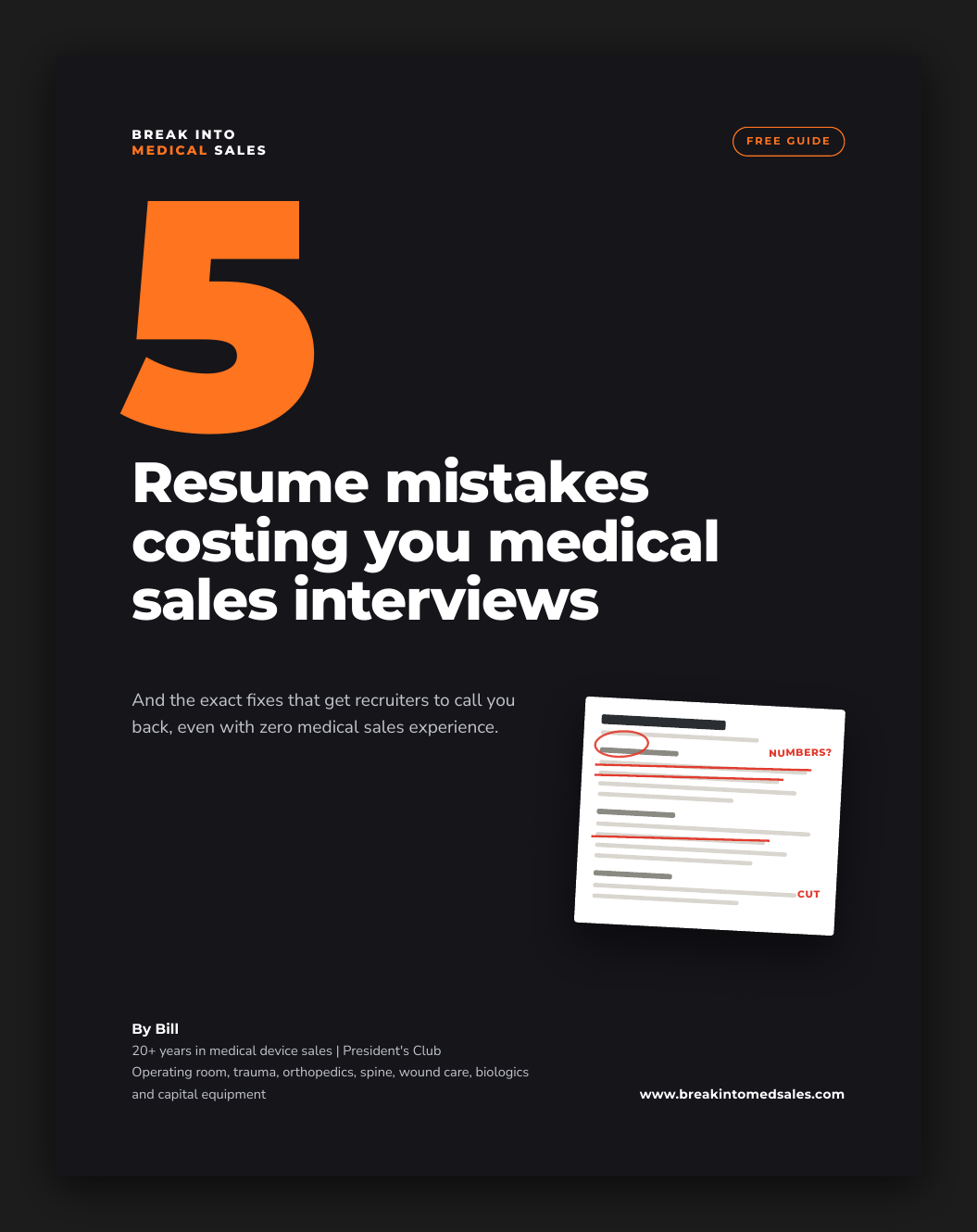
Free guide: 5 resume mistakes costing you medical sales interviews, with the exact fixes. Get the free resume guide
Can you really get into medical sales with no experience?
Yes. Medical sales does not require a specific degree or background. Many reps come from completely unrelated fields. What they share are the traits hiring managers trust:
- Coachability: you take feedback and improve fast
- Confidence: you can hold your own with surgeons and decision-makers
- Communication: you are clear, concise and persuasive
- Persistence: you follow up and stay organized without being told
- Energy: you bring the same effort on day 200 as on day 1
Hiring managers are not looking for perfect resumes. They are looking for low-risk hires. Your whole job search is about making the decision to hire you feel safe.
Who gets hired into medical sales without experience?
These backgrounds break in all the time:
- College athletes: grit, coachability and a team-first mindset
- Military veterans: discipline, mission focus and leadership. Many companies actively recruit veterans
- Nurses and healthcare workers: you already know the OR, the sterile field and clinical language
- Teachers and coaches: you educate, handle objections and adapt on the fly every day
- B2B and retail sales pros: you already live with a quota
- Servers and hospitality pros: people skills, pressure and endurance every shift
You do not need a "sales" title. You need transferable proof, framed the right way.
Step 1: Pick your segment
Medical sales is four different jobs. Choosing one makes your resume, outreach and interviews sharper.
- Pharmaceutical sales: prescription medications, shorter sales cycles (1-3 months), structured training. Very entry-level friendly.
- Medical device sales: surgical tools, implants, robotics and capital equipment. Longer cycles (3-12+ months), time in the OR, high earning potential. Competitive, but very possible with hustle and networking.
- Diagnostics and lab sales: test kits, imaging and lab equipment. Often less competitive for newcomers.
- MedTech SaaS: software for clinics and health systems. A natural fit if you come from tech or SaaS.
Want structure and a fast start? Look at pharma. Love pressure, procedures and being in the room when it matters? Device will pull you in.
Step 2: Write your "why" and your 30-second story
You will be asked "Why medical sales?" in every conversation. A vague or money-only answer blends in. Write down why this industry, why now and why you. Then turn it into a 30-second story:
- Where you come from (one line)
- Proof you can win (one result with a number)
- Why medical sales, and why now (one line)
- What you are already doing about it (one line)
Example for a veteran: "I spent eight years in the Army as a logistics NCO, leading a team of 15 and managing millions in equipment with zero losses. I want a role with the same mission focus and accountability, and medical sales fits that. I'm completing a medical terminology course and talking with veterans who've made the same move."
Say it out loud until it sounds like you, not a script.
Step 3: Rebuild your resume around numbers
Recruiters give the top third of your resume about seven seconds. If it reads like a list of duties, they move on. Medical sales is a numbers job, so your resume should be too.
- Replace "Responsible for customer service" with something like "Grew store revenue 18% year over year and ranked #2 of 40 locations."
- Put a number in most bullets: percentages, dollars, rankings, counts.
- Drop the objective line. Lead with a summary built around your best win.
- Keep it to one clean page.
Our full breakdown is here: Medical device sales resume: how to write one with no experience.
Step 4: Fix your LinkedIn
Hiring managers check LinkedIn before they ever call you. At minimum you need a clean photo, a headline that signals intent (for example "Aspiring Medical Sales Rep | B2B Background | Driven and Coachable"), an About section that tells your why, and experience written as outcomes. Then post or comment weekly. Recruiters notice activity.
Step 5: Network with reps before you apply
Many medical sales roles are filled through referrals, recruiters and internal networks before they ever hit a job board. That is why cold outreach matters more than applications.
Your goal is not to ask for a job. It is to ask for insight and become familiar. Keep messages short and specific:
"Hi [Name], I came across your profile and saw your path into medical sales. I'm working hard to break in and would love to hear how you got started. Would you be open to a quick message exchange or a 5-minute call?"
A simple weekly rhythm works: message 5 new people on Monday, follow up with 3 on Wednesday, and engage with posts from target companies on Friday. Track everything.
Step 6: Look beyond LinkedIn job posts
The best roles are often filled before they are posted. Widen your search:
- Niche boards like MedReps, and RepVue for real pay and culture data
- Careers pages of major manufacturers, with job alerts turned on
- Independent distributors and 1099 roles, which often hire fast and off-platform
- Medical sales recruiters in your region
- Private Facebook groups and your college alumni network
You do not need 1,000 applications. You need 10 targeted ones with follow-up.
Step 7: Prepare for a multi-stage interview
Most companies run four or five rounds: a recruiter screen, a hiring manager interview, a panel, a role play or presentation, and a final interview or field ride-along. Every round asks the same question in a different way: can this person represent us in front of physicians?
Prepare four or five STAR stories, practice "sell me this pen," and always close the interview by asking about next steps. See Medical sales interview questions and how to answer them. For the final round, bring a written plan: How to build a 30-60-90 day plan for a medical sales interview.
Your first 7 days
- Pick your target segment and write your why
- Rewrite your resume summary and top three bullets with numbers
- Update your LinkedIn headline, photo and About section
- Build a list of 20 target companies and set job alerts
- Send your first 5 outreach messages to reps or hiring managers
- Practice your 30-second story and three STAR stories out loud
- Log everything in a tracker and plan next week
Then repeat the outreach, follow-up and practice every week. Momentum builds faster than you think.
Get the free resume guide
Your resume is the first thing standing between you and an interview. Our free guide shows the 5 resume mistakes that cost career changers medical sales interviews, with real before and after examples and a message template that gets hiring managers to reply.
Download the free resume guide
Ready for the full plan? The Medical Sales Starter Kit includes the step-by-step guide, interview Q&A cheat sheet, cold outreach templates, resume template and job tracker.
Frequently asked questions
How long does it take to get into medical sales?
It varies, but candidates who treat the search like a campaign, with weekly outreach, follow-up and interview practice, usually see interviews within a few months. People who only apply online and wait often stall much longer.
Do you need a degree to get into medical sales?
Most companies prefer a bachelor's degree, but it does not need to be in science. Proof of results, coachability and work ethic matter far more than your major.
What is the best entry-level medical sales job?
The associate sales rep role is the most common way in for career changers. You support a senior rep while you learn the products, the accounts and the OR, then move into your own territory.
How much do entry-level medical sales reps make?
Pay varies widely by company, segment and region. Entry-level roles commonly combine a base salary with commission or bonus, and device roles tend to pay the most over time. Check RepVue for current, rep-reported base and on-target earnings for any company you target.
Is medical sales hard to get into?
It is competitive, but it rewards preparation over credentials. Most candidates apply blindly and wait. If you network, quantify your results and prepare for every interview stage, you will stand out.
Should I get a medical sales certification?
You do not need one to get hired. Training can help if your outreach is strong but you are not getting interviews, or if you want structured exposure to the industry. It should support your effort, not replace it.
FREE RESUME GUIDE
5 resume mistakes costing you medical sales interviews, with real before and after fixes and a message template that gets hiring managers to reply.
Ready for the full plan? The Medical Sales Starter Kit has the step-by-step guide, interview cheat sheet, outreach templates and job tracker. See the kit
Break Into Medical Sales
Step-by-step guides and tools for career changers breaking into medical sales - built from 20+ years in medical device sales.
Quick links
Free resume guide
5 resume mistakes costing you medical sales interviews, and how to fix them.
Created with © systeme.io